

The Support Gap: Why AI Is Rewriting the Rules of Workplace Mental Health
Dr. Max Major
29 June 2026
Content
- Change isn't breaking people. Uncertainty is.
- Employees don't live in crisis
- The story of Jim
- Why expectations have changed
- Safety is the thing.
- What excites him most
"We're not trying to solve for more therapy," said Dr. Max Major, Head of Clinical AI at Unmind. "We're trying to help people get support sooner, instead of struggling for months before they can access something."
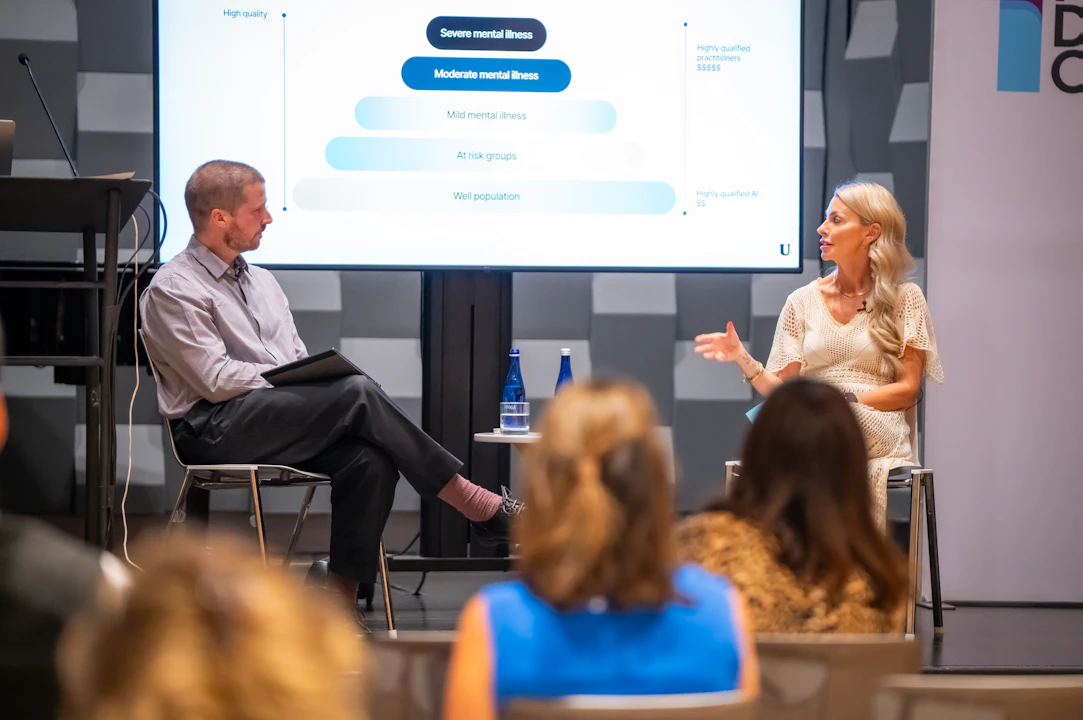
That idea sat at the center of a conversation between Dr. Max Major and Angela Lindberg, SHRM-SCP, PhD, at From Day One in New York. While AI dominated much of the conference agenda, their discussion wasn't really about technology.
It was about something much more human.
What happens when the way people experience life changes, but the way we support them at work doesn't?
Change isn't breaking people. Uncertainty is.
Angela kicked things off with a question familiar to almost everyone in the room.
Who here isn't going through some kind of transformation?
Nobody raised their hand.
That wasn't surprising.
But what Dr. Major said next shifted the conversation away from change itself.
"Change doesn't break people," he said. "Uncertainty does."
And uncertainty, he argued, is no longer an occasional event.
"It's become more like the weather. It's just constant."
As humans, our brains are always trying to predict what's coming next. When they can't, that uncertainty starts to feel like a threat. Left unchecked, it contributes to stress, burnout, and eventually poor physical and mental health.
That's why organizations experiencing transformation often see a corresponding rise in mental health concerns. And it's why many leaders are finding that old support models aren't keeping pace.
Employees don't live in crisis
The problem, according to Dr. Major, is that most systems are designed for the wrong part of the population.
"Most people in your organization aren't going to call a crisis helpline, and they might not even book a therapy session."
Instead, they're living somewhere in the middle.
They're stressed. They're tired. They're trying to manage uncertainty, family responsibilities, and work demands.
"The majority want prevention first," he said. "Something that fits into their daily workflow."
Yet traditional systems often require people to wait until things get much worse.
"The system is reactive by design," he explained. "It asks people to get worse before they can access the care they should have received much sooner."
The story of Jim
To illustrate what that looks like, Dr. Major shared the story of Jim, a man he worked with as a clinical psychologist.
Jim wasn't in crisis, at least not at first.
His workload increased. Stress started building. He tried the tools available to him, but when he sought help for the stress itself, he was told he didn't qualify.
"He wasn't in crisis. He didn't have a severe mental health condition. He was just sort of left with nothing."
Eventually, Jim was signed off work. Only then could he access support.
"The system made someone fall apart in order to get help."
And by that point, the costs had already spread beyond the individual.
His productivity suffered. Teammates picked up the slack. Managers were caught between supporting their employee and delivering business results. The organisation, having offered him nothing when the need was still manageable, was now dealing with the full consequences of waiting too long.
"I'm sure everyone in this room can think of someone in their organization who's in a similar position," Dr. Major said.
Why expectations have changed
Angela pointed out that employees today live in a world that's instant, personalized, and conversational. But when they need support at work?
"They have a form to fill out, a phone line to call, and they might wait six weeks before speaking to somebody."
Dr. Major calls this the expectation gap. People don't expect therapy on demand. But they do expect support to fit into their lives.
And increasingly, they're turning to AI.
In fact, as Angela noted, mental health and companionship have become one of the most common use cases for AI. The problem is that many people are relying on tools that were never designed for that purpose.
Safety is the thing.
The pair didn't avoid the difficult headlines around AI and mental health.
Instead, they addressed them directly.
"These stories aren't really about AI," Dr. Major said. "They're about general-purpose tools being repurposed for mental health."
That's why he believes employers should ask three questions when evaluating AI tools:
- How are they designed for safety?
- Who built them?
- Where's the evidence?
"If a vendor can't answer safety, governance and evidence," he said, "that's really your answer."
And despite all the speculation around AI replacing therapists, Dr. Major's answer was refreshingly simple.
"Well-designed AI won't replace therapists. And poorly designed AI shouldn't."
What excites him most
Toward the end of the conversation, Angela asked Dr. Major what he's most excited about right now.
His answer wasn't another chatbot.
It was measurement.
For years, organizations have relied on surveys to understand whether wellbeing investments are working. But surveys are often incomplete and retrospective.
"The signal arrives too late to act on," he said.
Instead, his team is exploring whether conversational patterns could help organisations understand, sooner, whether wellbeing support is actually reaching people.
For leaders under increasing pressure to prove the impact of wellbeing investments, that shift could be significant.
Because perhaps the biggest message from the session wasn't about AI at all.
It was about timing.
"Most people don't need high-level treatment," Dr. Major said.
"They need support earlier."
And maybe that's the real opportunity in front of organizations – not replacing human care, but making sure people don't have to wait until they're struggling to deserve it.
About the Author
Dr. Max Major, Principal Clinical Psychologist, AI
Dr Max Major, PhD, leads the clinical safety, ethics, and governance of all AI innovation and serving as the clinical architect behind Nova, Unmind’s AI mental health agent. A registered Clinical Psychologist with a decade of experience across New Zealand and the NHS, he brings deep expertise in clinical AI, digital transformation, and the neuroscience of decision-making.
About the Author
Dr. Max Major, Principal Clinical Psychologist, AI
Dr Max Major, PhD, leads the clinical safety, ethics, and governance of all AI innovation and serving as the clinical architect behind Nova, Unmind’s AI mental health agent. A registered Clinical Psychologist with a decade of experience across New Zealand and the NHS, he brings deep expertise in clinical AI, digital transformation, and the neuroscience of decision-making.